
21:34Still deciding. Still asking.
Interest doesn't arrive between nine and five, and it rarely waits until the morning for a reply.
AI Receptionist · Customer service · WhatsApp
Give customers an easy way to ask and get a useful answer at any time. We build managed AI Receptionist solutions around your approved knowledge, connecting WhatsApp, automation and your team.
AI when it helps. Automation when it makes sense. People when they matter.
Is the spa included if I book a superior room?
Superior rooms include the thermal suite for two. Treatments are booked separately.
Could we get a couples massage on the Saturday?
That one needs the spa team to check the diary. Passing you to Nadia now, with your dates.
Answered in seconds · handover when it matters
The gap between interest and response
Someone is comparing venues at half nine at night. Looking at gyms before work. Checking a hotel policy after reception has closed. Or hunting for an answer buried somewhere on your website.
They are interested now. The question is whether your customer journey can respond while that interest is still there.
21:34Still deciding. Still asking.
Interest doesn't arrive between nine and five, and it rarely waits until the morning for a reply.
A good prospect waits until the next working day.
Opening times, parking, prices, availability, what's included, where to go.
It's spread across webpages, PDFs, policies and booking systems.
Real customers rarely phrase a question the way a menu expects.
Handover should be easy, not a loop the customer can't escape.
You have already done the difficult part by creating the interest. An AI Receptionist closes the gap between somebody asking and somebody getting a useful next step.
What it can do
A useful AI Receptionist doesn't just return information. It helps the customer move forward.
Customers type what they want to know instead of hunting for the right button.
Answers grounded in sources you choose, not generic information or guesswork.
Clarify what the customer needs and collect what decides the next step.
The right booking link, enquiry route, registration page, document or contact.
Names, dates, requirements and preferences, passed into the next stage.
When judgement or expertise is needed, it routes onwards with the context intact.

The knowledge behind the answer
Connecting an AI model to a chat window is the easy part. The value is in deciding what it should know, where that knowledge comes from and what it does when the answer isn't clear.
Knowledge you approve
Answers built from the sources you approve, not from the open internet
The boundaries we agree with you
What it should answer
What it must never assume
Where to ask a follow-up
When to offer a next action
When knowledge needs updating
When to hand to a person
The aim isn't AI that sounds confident about everything. It's AI that is genuinely useful about the information your business can stand behind.
A managed service
Plenty of AI tools hand you a login and leave you to build the rest. That isn't our model.
We look at what customers ask now and where those enquiries land. Then we design the conversation, prepare the knowledge, connect the technology, test it against real questions and keep improving it once customers are using it.
The technology matters. The service is in making it useful for your customer journey.
AI + automation
Some interactions are better structured. Others need an open conversation. The strongest solutions use both, designed to work together.
“Book a show-around” suits a short structured journey. “Would this work for 90 guests with rooms for 40?” is a much better use of conversational AI.
AI + people
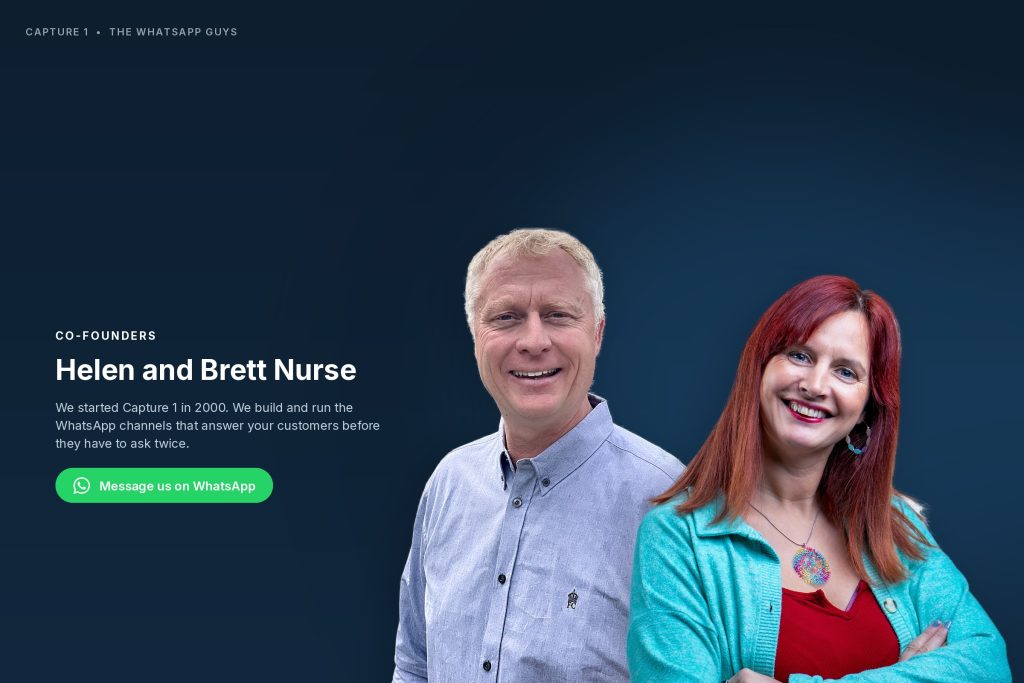
Sometimes the most useful thing an AI Receptionist can do is recognise that the customer needs a person. Routine information is handled quickly and consistently; the unusual, sensitive or commercially important conversations are passed on.
When a person takes over, the customer doesn't start again. The team sees the context and continues from where the automated journey stopped.
Where the conversation starts
The AI Receptionist sits behind a WhatsApp channel customers can reach whichever way suits the journey.
An “Ask us on WhatsApp” route turns browsing into a live conversation.
Hotel rooms, venues, attractions, receptions, events and printed material.
A click opens a relevant enquiry journey rather than another form.
Customers ask in a channel they already know how to use.
A confirmation or reminder leads naturally into “need anything else?”
Example customer journeys
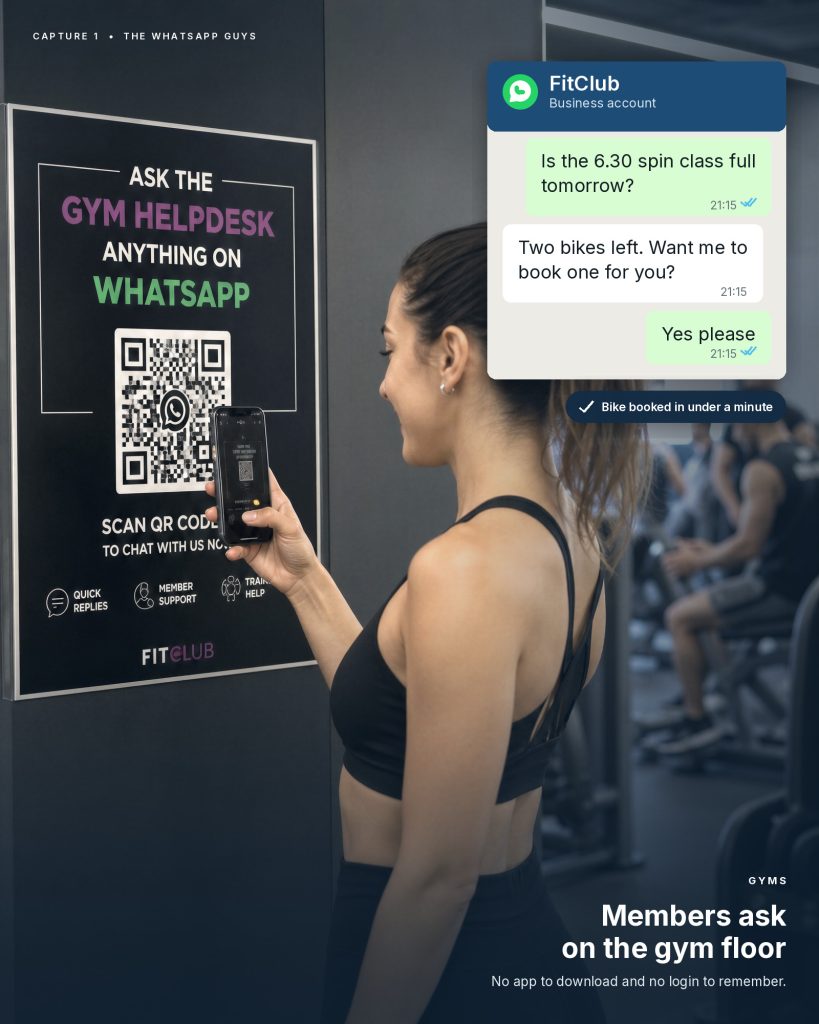
Gyms & leisure“I can only train before work. Which membership would suit?”
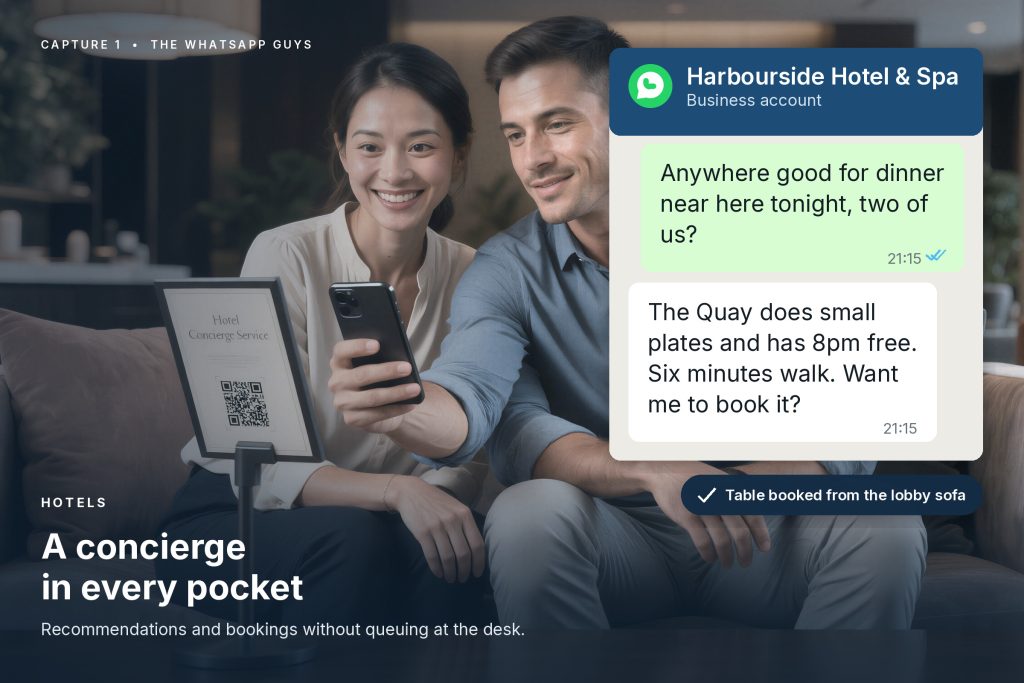
Hotels & hospitality“Is the spa included if I book a superior room?”
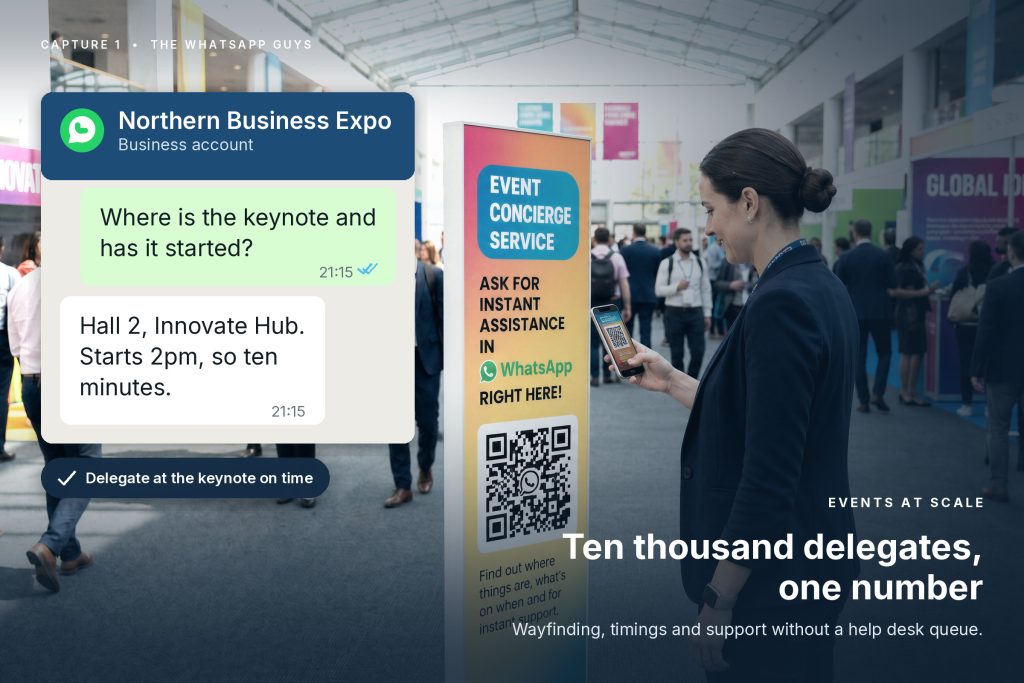
Events & exhibitions“I'm coming from Germany. Do you provide visa invitation letters?”
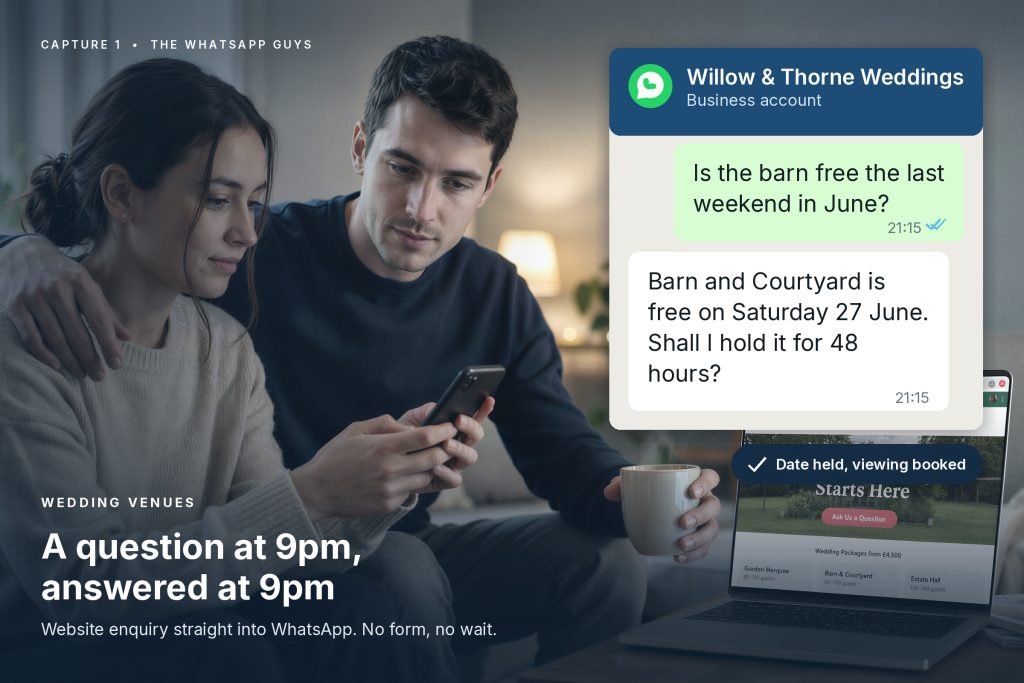
Wedding venues“September next year, around 90 people. Can you help?”
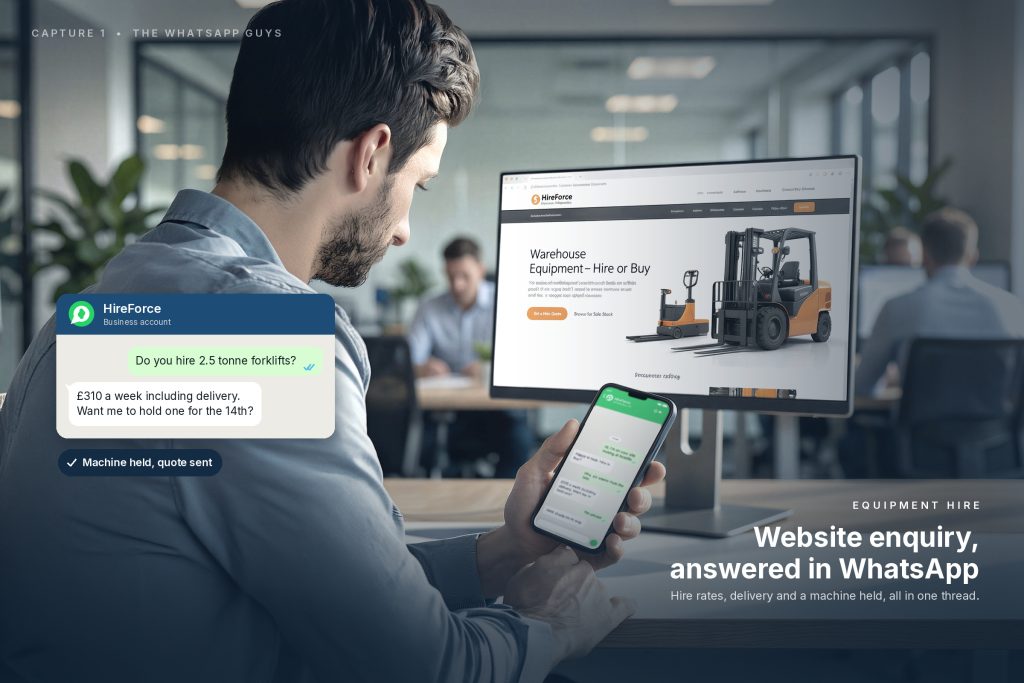
Enquiry-led services“I'm interested, but I'm not sure which option is right for me.”
How it works
A useful AI Receptionist isn't one piece of software. It's a customer journey made from several connected layers.
01 Customer channel
Structured journeys handle the predictable tasks: qualification, data capture, booking routes and reminders.
Open questions pass into the AI layer.
reads
Webpages, documents, FAQs and policies you approve.
Routine questions answered straight away, with the next action offered there and then.
Anything needing a person routes to the team with the conversation history intact.
06 Connected systems
Capture 1 designs how those layers work together. You're not buying a chatbot and being left to assemble the rest.
Proven in live customer communication
The knowledge and escalation model behind our AI Receptionist is already running in live WhatsApp journeys. Across Nineteen Group event implementations, AI-assisted live chat handled the routine attendee questions automatically and left the genuinely unusual cases for the team.
Typical questions: badge help, agendas, visa letters, venue information, ticket benefits and on-site facilities.
This is proof of the underlying AI handling model in live customer conversations. It is not presented as a dedicated AI Receptionist case study.
What it changes for your team
Without automation, a simple question becomes a long manual job: somebody sees the message, finds the answer, types a reply, waits, then starts again.
With a well-designed AI Receptionist, routine information is handled immediately, the next action is offered there and then, and anything needing your team arrives with more context than it started with.
The goal isn't removing people from customer service. It's not using people for the parts technology handles faster and more consistently.

Is it right for you?
It could be a strong fit if:
It may not be necessary if almost every enquiry is genuinely unique and needs an expert immediately, or if there is little reliable information for an AI to answer from safely. We would rather identify that early than put AI into a customer journey simply because AI is available.
A Capture 1 AI Receptionist project
Where enquiries come from, what customers ask, how the team handles it now and where things slow down.
Bring together the approved information and agree what it can answer, qualify or escalate.
Structured automation, open AI questions, next actions, integrations and human handover in one journey.
Normal questions, follow-ups, edge cases and the things it should not answer.
Real conversations show us what to refine once customers start using the channel.
Common questions
An automated customer communication system that answers questions, provides information, collects details, guides next actions and passes a conversation to a person where appropriate. We focus on WhatsApp and online enquiry journeys rather than telephone answering.
Yes. Customers already understand how to ask questions there and can continue the same conversation over time. We use the official WhatsApp Business Platform and build the automation and AI behind the channel.
Not necessarily. A traditional chatbot relies on menus and pre-written decision trees. Our approach combines structured journeys with conversational AI, so customers can also ask open questions in their own words.
Knowledge is built from sources you approve: webpages, FAQs, policies, PDFs, brochures, event information and service or product guidance. The structure depends on your organisation.
It's designed with boundaries. Where information is unclear or better handled by a person, the right behaviour may be to ask another question, say it can't confirm the answer, or hand the conversation over.
Yes. Human handover is part of the design. The team sees the conversation context and continues from where the automated journey stopped, rather than asking the customer to begin again.
Often, yes. Journeys can connect with CRM, booking, registration, spreadsheets and marketing platforms. We scope integrations around what will genuinely improve the customer journey.
Yes. Business information changes, and the sources and guidance behind the AI can be reviewed and updated as services, policies, events or customer questions change.
Automated and AI responses can be available outside working hours. Human handover then follows the service model you choose, so customers know when a person will respond.
It depends on the complexity of the journey, the amount of knowledge involved and any integrations. We scope the build around the real use case rather than a fixed package.
Start with the questions
Show us the questions customers ask and where those conversations arrive. We'll help you work out where AI, automation and people make the journey faster and easier to manage.
No need to arrive with the technology worked out. Start with the communication problem.