The UK fitness market is at record scale. According to the 2026 ukactive market report referenced in our new 24/7 Membership Desk research, 12.2 million people are now members of a UK health and fitness club, with 679 million club visits recorded in 2025.
That is a big market. But it does not mean growth happens automatically.
A prospective member can still disappear over something very small: they cannot work out whether spa access is included, they are unsure whether they can use both sites, they want to know if there is a pool, or they simply want to book a look around at the weekend.
And quite often, they are asking those questions when the membership desk is closed.
The membership journey now starts before someone speaks to a person
Think about a fairly normal evening. Someone gets home from work, searches for a gym, compares two or three clubs and starts looking at memberships.
They are not necessarily ready to join immediately. But they are already in a buying journey.
A website can provide information and a form can capture their details. What neither automatically does is create a useful two-way conversation at the exact moment the question appears.
That is the gap we have been looking at with gyms, spas and health clubs: what would a membership desk look like if the physical desk could close, but the useful part of the conversation did not have to?
There is an invisible middle between interest and joining
Membership decisions are rarely a neat website-to-checkout transaction.
Someone may discover the club on Google, explore the website, ask a question in WhatsApp, come back later, visit the club, speak to a membership adviser and then join online.
That makes attribution messy, but it also changes the question operators should ask. Instead of only asking, ‘Did WhatsApp close the sale?’, a better question is, ‘Did this conversation remove a doubt or move the person closer to joining?’
In a live two-site health-club deployment referenced in our report, around 30 to 40 people who subsequently became members had interacted with the WhatsApp journey during each of two recent months. Against around 180 to 200 monthly joiners, that means the journey was visibly present somewhere in roughly 15 to 22% of new-member journeys during that period.
We would not claim WhatsApp caused every one of those joins. It did not. People move between channels. But it is increasingly clear that responsive conversation is becoming a meaningful part of the membership journey.
The best AI membership desk does not try to do everything
This is where AI can be genuinely useful, provided it is designed around the real job.
Routine questions such as opening times, prices, facilities, class basics, parking, guest rules and membership inclusions can often be answered immediately from approved club information.
A prospect can also ask naturally: ‘I mainly want swimming. Which membership makes sense?’ or ‘I haven’t been in a gym for years. Can I come and look around first?’
The system can answer what it knows, understand the intent and ask the next useful question.
What it should not do is pretend to replace a good membership adviser.
Show-arounds, nervous first-time members, complaints, exceptions and more commercially important conversations still benefit from people. The better model is digital first, not digital only.
Nurture the interest. Do not interrogate it.
One of the easiest mistakes with automation is turning a simple enquiry into a qualification form disguised as a conversation.
A good membership journey should ask only what helps.
If someone says they are mainly interested in gym and swimming, you can explain the memberships that include both. If they would rather see the club, offer a route to a tour. If they ask about spa access, answer it. If they need a person, hand over.
The membership adviser receiving ‘prospect wants gym + swimming and would like a weekend tour’ has a much better starting point than receiving ‘new website lead’.
That handover is part of the customer experience, not the point where the automation has failed.
The value continues after somebody joins
The same conversational front door can also help existing members.
What time does the pool close? Can I bring a guest? How do I book a class? Can my children swim this evening? Can I freeze my membership? Where do I park?
Some questions can be answered instantly. Some should link to an existing booking or member system. Some need reception, membership, spa or fitness staff.
The member should not have to understand which internal department owns the question. The system should understand enough to answer it, guide it, route it or escalate it.
Start with the highest-value friction, not a plan to automate everything
Before introducing AI, we think operators should answer seven practical questions: what are people asking today, which questions are routine, where the correct knowledge lives, what should happen after the key membership enquiries, who should receive human handovers, what success looks like, and which use cases are worth launching first.
The best AI receptionist may not be the one that does the most. It may be the one that knows exactly what it should do, and exactly when somebody else should take over.
That is the thinking behind our new report, The 24/7 Membership Desk, which looks in more detail at membership growth, member service, WhatsApp, AI and the role of the human team.
Get the FREE 24/7 Membership Desk report
If you run a gym, spa, health club or membership business, we have pulled the full thinking, current market data and practical model into a free report.
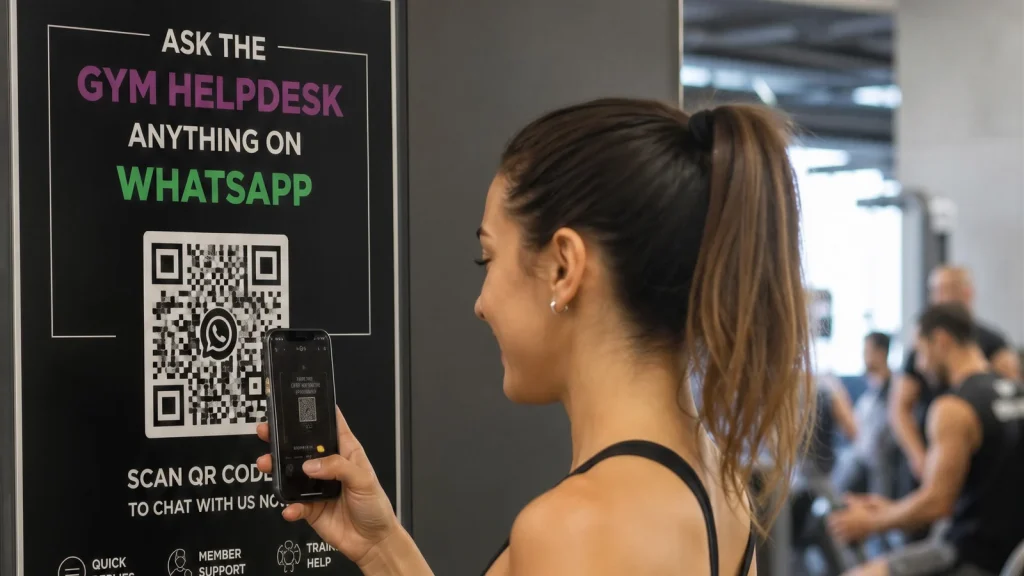
We can send The 24/7 Membership Desk straight to you in WhatsApp.
CTA: Get the FREE report in WhatsApp